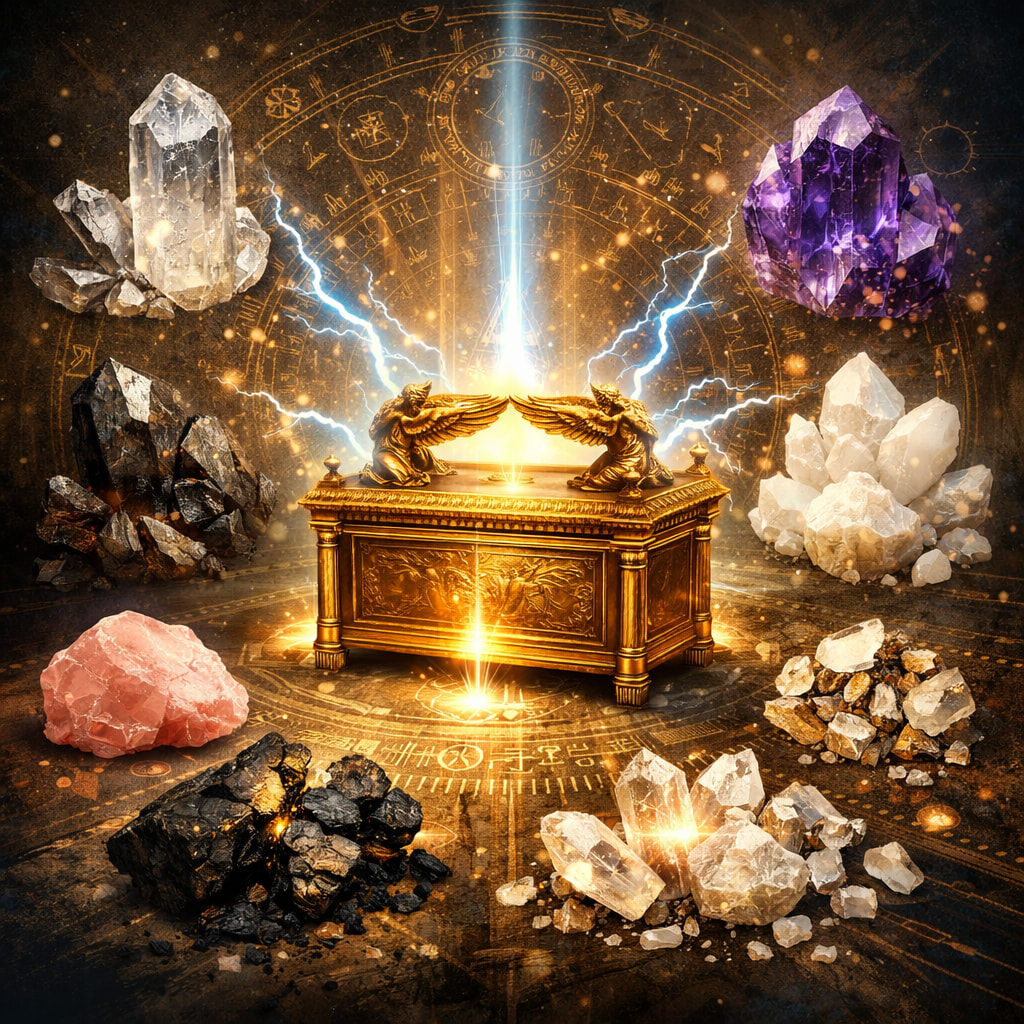
The Ark of the Covenant, Sacred Technologies, and a New Materials Hypothesis: Calcined Quartz Variants
Throughout history, the Ark of the Covenant has stood at the crossroads of religion, symbolism, mystery, and speculative technology. In mainstream historical scholarship, it is understood primarily as a sacred cultic object of ancient Israel described in biblical tradition. Yet outside conventional scholarship, a long line of independent researchers, alternative historians, and esoteric writers have explored whether the Ark may also encode lost principles of material science, resonance, electricity, ritual architecture, or sacred engineering.
This post does not claim that such theories are proven. Instead, it maps a research lineage and introduces a fresh hypothesis: whether different calcined quartz families could be explored as a safer and more grounded materials framework for studying “Ark-like” concepts of resonance, insulation, charge behavior, crystalline order, and symbolic sacred technology.
1) The Ark as sacred object, symbol, and technological speculation
In the biblical tradition, the Ark is presented as the holiest object of the Israelites: a gold-covered chest associated with the covenant, the tablets of the law, and the divine presence. Historically and religiously, that is the primary frame.
Over time, however, the Ark also became a subject of nontraditional interpretation. Some writers treated it not only as a religious object, but as a device whose descriptions might hint at unusual interactions involving charge, energy, resonance, or ritual access control. These ideas remain speculative, but they have formed a recognizable stream of alternative literature.
2) Pioneers and key research lines
A useful way to organize the field is to separate historical-context scholars from alternative/esoteric interpreters.
Historical and contextual line
David A. Falk is one of the more academically grounded modern authors on the Ark’s material and Egyptian context. His work places the Ark within the broader world of Egyptian archaeology, ritual furniture, and ancient Near Eastern cultural patterns rather than modern techno-mysticism.
This line is valuable because it gives a disciplined baseline: before turning the Ark into a machine, one should understand it as an ancient ritual object in its own historical environment.
Alternative-history and esoteric line
Graham Hancock popularized one of the best-known modern alternative investigations through The Sign and the Seal (1992), where he pursued the Ark’s possible historical movements and its connection to Ethiopia. The book became influential, though it is generally classified as pseudoarchaeological rather than mainstream scholarship.
Laurence Gardner pushed the subject further into esoteric metallurgy and sacred-material interpretations, explicitly linking the Ark with ideas about gold and hidden ancient power. His work is important for the symbolic-alchemical branch of the topic, even though it is not accepted as conventional history.
Andrew Collins belongs to the broader family of independent researchers who connect ancient sacred sites, altered states, earth energies, and lost knowledge systems. Even when not limited only to the Ark, this school of thought helps frame why the Ark keeps reappearing in discussions of ancient technology and consciousness studies.
3) Why the Ark continues to fascinate researchers
The Ark remains compelling because it sits between multiple domains at once:
- sacred law and ritual authority
- portable shrine technology
- precious materials and symbolic geometry
- fear, access restriction, and taboo
- mystery of disappearance
- possibility of encoded material principles
For some, this makes it a theological object.
For others, a political relic.
For others, a symbolic capacitor, resonant chest, or sacred-interface device.
None of those technological readings are established fact. But as a research framework, they raise a useful question: if ancient sacred objects were designed to optimize specific material behaviors, what classes of materials would be worth studying today?
4) A safer modern hypothesis: calcined quartz families
Here is where a more careful and original line of inquiry can begin.
Instead of jumping immediately into exotic claims about metals, monoatomic states, or ingestible substances, a more grounded path would be to explore different quartz families after controlled calcination, purely as a materials and resonance study.
Quartz is already central to many modern technological domains because of its crystalline order, piezoelectric relevance in certain contexts, and long-standing association with frequency stability and oscillation systems. Different silica-rich and quartz-based materials can also behave differently depending on purity, inclusions, thermal history, and structural disorder.
Why quartz is interesting in an “Ark research” framework
Quartz sits at an unusual intersection of:
- crystal order
- thermal transformation
- ritual/symbolic history
- resonance metaphors
- practical relevance to signal, vibration, and structure
That makes it a much better candidate for a serious speculative program than jumping straight into unsafe bioactive claims.
5) The novelty: not one quartz, but multiple calcined quartz archetypes
A more advanced concept would be to compare different quartz-derived starting materials, for example:
- clear quartz
- smoky quartz
- rose quartz
- amethyst
- milky quartz
- quartzite or high-silica mineral variants
The novelty is not merely “calcining quartz,” but studying whether distinct quartz archetypes, after equivalent thermal treatment, exhibit different structural, optical, textural, dielectric, or symbolic profiles.
That would allow two simultaneous readings:
Materials-science reading
Do different quartz variants respond differently to heat in terms of:
- fracture pattern
- opacity change
- grain behavior
- surface reactivity
- mechanical brittleness
- residual structural order
Symbolic-esoteric reading
Does each quartz lineage preserve a distinct “identity” even after thermal resetting?
That question belongs more to metaphysics than laboratory science, but it is a coherent conceptual question for a private research forum.
6) Why calcination matters conceptually
Calcination has always carried a double meaning:
On the practical side, it is a thermal transformation that can alter a material’s structure, impurities, stress state, and surface condition.
On the symbolic side, it represents purification, reduction to essentials, and liberation of hidden order.
That is precisely why it fits the Ark theme so well.
The Ark, in speculative traditions, is often imagined as a vessel where matter, law, geometry, and sacred force converge. Calcined quartz research offers a cleaner way to explore that symbolism through real materials, without making unsupported claims about miraculous products.
7) A better framing than “proof”
The strongest version of this post is not:
“The Ark was a machine and calcined quartz proves it.”
That would be too strong and not defensible.
A better framing is:
“Across both historical and alternative traditions, the Ark has been imagined as a sacred object whose design may have encoded advanced material symbolism. As a modern research analogy, comparing calcined quartz families could provide a structured way to explore how crystalline materials retain or transform identity through fire.”
That is interesting, serious, and publishable.
8) Research direction for a private forum
For a private research community, this topic could open three parallel tracks:
Historical track
Map the main Ark researchers and distinguish:
- scripture and theology
- archaeology and Egyptology
- alternative-history speculation
- esoteric materials theories
Materials track
Study calcined quartz families as:
- ritual-material analogues
- resonance candidates
- symbolic carriers of crystalline order
Conceptual track
Explore whether ancient sacred technologies can be reinterpreted as:
- interfaces between geometry and ritual
- controlled material environments
- symbolic containers for law, sound, and presence
9) Final reflection
Whether one sees the Ark as relic, mythic center, ritual throne, or coded technology, it continues to inspire because it points to an old dream: that matter can be arranged in ways that mediate power, order, and consciousness. The most productive modern response may not be to imitate extreme claims, but to begin with disciplined curiosity.
In that sense, the idea of comparing different calcined quartz lineages is genuinely new. It preserves the symbolic depth of the Ark tradition while moving the conversation toward a more coherent material framework.
Not as dogma.
Not as proof.
But as a frontier worth thinking about.